



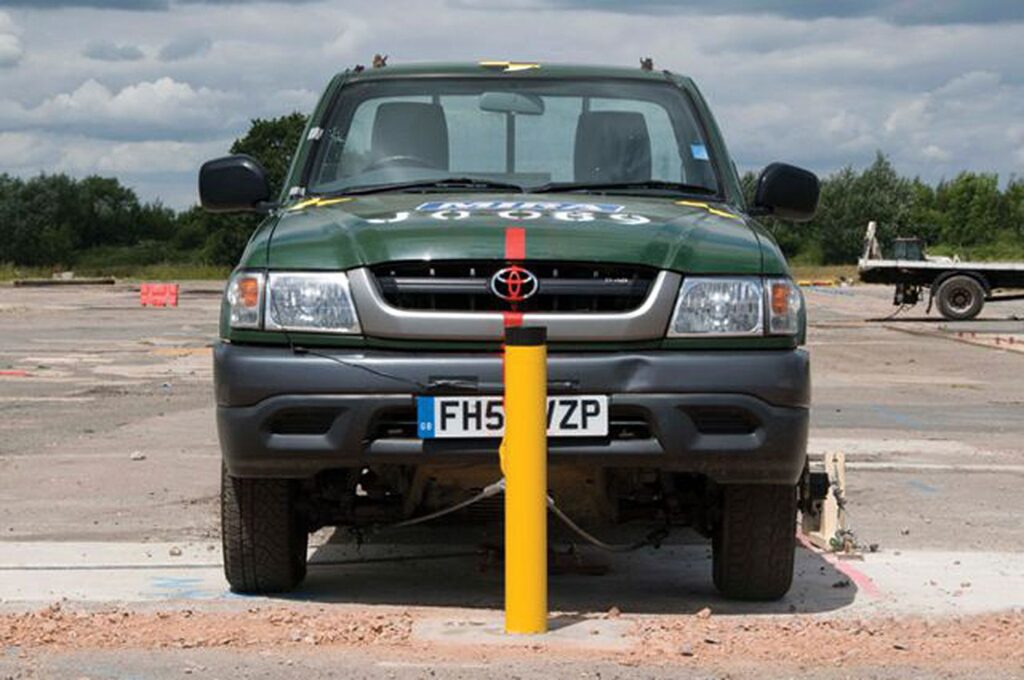
Can a Bollard Stop a Car? A Guide to Vehicle Impact Protection
There is a common misconception that all bollards, no matter what type, offer the same level of protection against a moving vehicle.
In reality, a bollard’s ability to stop a vehicle depends on several key factors, including its design, installation method and whether it has been crash tested.
In this guide, we explore how strong bollards really are, how much force they can withstand, and when they are effective for vehicle impact protection.
Are bollards supposed to stop cars?
When selecting a bollard, it is important to understand that not all bollards are designed to stop vehicles.
Some bollards are purely decorative or used for light traffic management, such as guiding vehicles or marking boundaries. These are not intended to withstand impact and will offer little resistance if struck by a vehicle.
In contrast, security bollards are specifically engineered to resist vehicle impact. These products are typically manufactured from high-strength materials and are supported by technical data, testing certification and performance ratings.
Understanding this distinction is essential, particularly when bollards are being used to protect shopfronts, buildings or pedestrian areas. Choosing the wrong type of bollard can result in vehicles damaging buildings, or even harming civilians.
Can a bollard stop a car?
In short, yes, a bollard can stop a car, but only if it has been designed and installed to do so.
Lightweight or poorly installed bollards are unlikely to provide meaningful protection. However, a well-designed and correctly installed security bollard can prevent vehicle access and significantly reduce the risk of damage or theft.
Several factors determine how effective a bollard will be in stopping a vehicle. These include:
Material
The material used plays a significant role in how a bollard performs under impact. Materials are selected based on how they absorb and redistribute kinetic energy.
Steel is the most commonly used material for security bollards due to its high strength and durability. It provides an effective balance between rigidity and controlled deformation (the intentional change in an object’s shape or size), allowing the bollard to absorb impact without failing completely.
Foundation depth
The foundation is one of the most critical elements of a bollard’s performance. It acts as the anchor that transfers impact forces into the surrounding ground.
A deeper and properly constructed foundation increases stability and reduces the likelihood of the bollard being dislodged.
In crash-rated installations, this foundation is typically reinforced with a steel rebar cage, designed to bind the concrete together and prevent it from cracking or shearing under extreme loads.
These cages are carefully engineered so that, upon impact, kinetic energy is not concentrated at a single point but instead dispersed through the reinforced concrete mass and into the surrounding soil.
This energy distribution is essential in allowing the bollard to remain upright and functional after a collision. Without sufficient depth and reinforcement, even a strong bollard can fail under impact.
If you would like to explore this in more detail, you can read our guide on how deep a bollard needs to be.
Installation method
Installation quality is just as important as the bollard itself. A poorly installed bollard may concentrate force in one area, increasing the risk of failure.
In contrast, a professionally installed system incorporates correctly positioned reinforcement, appropriate concrete grades, and precise alignment to ensure the bollard and its foundation act as a single structural unit.
The rebar cage plays a crucial role here, tying the bollard into the foundation and enabling the structure to absorb and redistribute impact forces across a wider area of ground. This reduces stress concentrations and helps prevent localised cracking or pull-out.
How much force can a bollard take?
The amount of force a bollard can withstand depends largely on the weight and speed of the vehicle involved. A heavier vehicle travelling at a higher speed generates significantly more force on impact.
Rather than being measured as a single force value, bollard performance is typically defined through controlled crash testing. These tests simulate real-world impacts using vehicles of specific weights travelling at set speeds.
For example, some security-rated bollards are designed to stop a 7.5 tonne vehicle travelling at speeds of 30mph or more. Lower-specification bollards may only be suitable for slow-moving vehicles in low-risk environments.
This is why understanding the intended use of the bollard is so important when selecting the right product.
What are crash-rated bollards?
Crash-rated bollards are products that have been physically tested against vehicle impact under controlled conditions. This testing provides verified performance data, removing uncertainty around how the bollard will behave in a real-world scenario.
Before looking at crash ratings in more detail, it is worth understanding the difference between anti-ram and crash-rated bollards, as these terms are often confused within the security industry.
Anti-ram bollards are typically reinforced versions of standard bollards, often incorporating an internal steel tube or rolled steel joist (RSJ) to improve their strength and resistance to impact. While they can provide a higher level of protection against low to medium-force collisions, they are not usually tested or certified to stop a specific vehicle travelling at a defined speed.
Crash-rated bollards, on the other hand, are specifically engineered and independently tested to recognised standards. This means their performance has been verified against particular vehicle weights, speeds and impact scenarios, giving security professionals and site owners confidence in the level of protection they provide.
This distinction is important when specifying perimeter security. A bollard described as anti-ram may offer increased resistance to vehicle impact, but it is not automatically crash-rated. The most appropriate solution will depend on the level of risk, the site requirements and the type of threat being mitigated. It is also worth noting that crash-rated systems often require more substantial foundations and installation methods to achieve their certified performance levels, which can affect overall project costs.
Crash-rated bollards are tested against recognised standards that assess their ability to stop vehicles of specific weights travelling at defined speeds. Common standards include PAS 68, IWA 14-1 and the newer ISO 22343.
PAS 68 is a UK standard that has historically been widely used to test hostile vehicle mitigation products. IWA 14-1 is an internationally recognised agreement that provides a consistent framework for testing vehicle security barriers.
ISO 22343 is a more recent international standard that builds on previous testing methods and is becoming increasingly adopted globally. It does not replace PAS 68 entirely but helps standardise testing approaches across different regions.
These standards also measure how far a vehicle travels after impact, which is a key factor in determining the level of protection provided.
What is Hostile Vehicle Mitigation (HVM)?
Hostile Vehicle Mitigation, often referred to as HVM, is the use of physical security measures to prevent or reduce the impact of vehicle-based attacks.
HVM solutions are commonly used in high-risk environments such as stadiums, transport hubs, public venues and city centres. Their purpose is to stop or significantly slow vehicles before they can reach vulnerable areas.
Security bollards are a key part of HVM strategies, as they provide a physical barrier that cannot be bypassed in the same way as electronic security systems.
With the introduction of legislation such as Martyn’s Law, there is an increasing focus on implementing proportionate security measures in publicly accessible locations.
Bollard protection with Rhino Security
Bollards can stop vehicles, but only when they are correctly specified, properly installed and, where necessary, supported by verified crash ratings.
High-quality security and HVM bollards provide physical protection rather than acting as a visual deterrent alone. This makes them one of the most effective measures for preventing unauthorised vehicle access and reducing the risk of impact.
If you are unsure which bollard is right for your property or project, the team at Rhino Security can provide expert advice on product selection, layout and installation.
You can contact us on 01603 484999 or email sales@rhinosecurity.co.uk to discuss your requirements.